
Lake County Projected Versus Actual Release
A projected release date is a planning field. Minnesota DOC calls its public prospective field “Anticipated Release Date.” It is based on the sentence and the correctional calculation then in force. An actual release date records an event that has occurred. The DOC Conditions of Release form keeps these ideas separate through fields for Actual Release Date, Confinement Release Date, Termination Date, release status, and minimum or maximum confinement dates.
Pretrial custody works differently. A person held at Lake County Jail while a case is pending may have a bond condition, court date, or detention decision, but no sentenced release calculation. Court action, payment of bail, dismissal, a hold, or transfer may control the next custody change. A roster entry cannot safely be turned into a forecast.
Even after a forecast appears, confirm which system produced it. A Minnesota DOC anticipated date applies to state confinement. It should not be copied onto a Lake County jail sentence or a federal case. The county jail, sentencing court, DOC, and federal agencies make different calculations.
Find a Lake County Projected Release Date
Start by deciding whether the person is awaiting court action, serving a Lake County jail term, or serving a Minnesota prison sentence. The current jail roster is only a snapshot of who is listed now. It is not a release-date calculator. The DOC viewer is the right route only after a state commitment or for a person under DOC jurisdiction.
- Use the Lake County court case to confirm the disposition, executed sentence, credit for time served, and whether the court committed the person to Minnesota DOC.
- If the case is still pretrial, read the current court orders and contact the jail or Court Administration. Do not expect a fixed projected date.
- For a county-jail sentence, ask the Sheriff for the recorded release calculation and compare it with the sentencing order. Lake County publishes no online county good-time calculator.
- For a state-prison sentence, search the Minnesota DOC public viewer by DOC number or full legal name. Open the detail record and verify the birth date and case information.
- Copy the field label exactly. Record “Anticipated Release Date” as anticipated, then compare the current facility or supervision status before treating any release as complete.
- When data conflict, ask the agency that owns the calculation. A court can explain its order, the Sheriff its jail record, and DOC its state sentence audit.
The full county search and records sequence is available through the Lake County released-inmate record path. It distinguishes a person who left jail for the community from someone transferred into state custody. That distinction is vital because a transfer to DOC is not a community release.
Lake County DOC Release-Date Fields
An incarcerated DOC record may show the MNDOC Offender ID, legal names, birth date, current facility or status, sentence date, expiration date, caseworker, highest-ranked offense, court file numbers, and the Anticipated Release Date. These fields help identify the correct Lake County case and place the forecast in context.
| DOC field | How to read it |
|---|---|
| MNDOC Offender ID | The strongest public search key for matching a state correctional record |
| Current facility/status | Whether the person remains confined or has moved to supervision |
| Anticipated Release Date | A prospective confinement-release field, not proof of an event |
| Expiration date | A sentence or supervision endpoint field that is distinct from prison release |
| Under Supervision as of | Evidence that prison confinement ended and DOC community supervision began |
| Court file numbers | Links the DOC record back to the sentencing case for verification |
After release to supervision, the public record may replace the anticipated date with “Under Supervision as of” and list an agent or district. That change indicates release from prison confinement, not final discharge. A person may remain under DOC authority until a later termination or expiration event.
The DOC Conditions of Release form adds another layer when a formal record is available. It distinguishes the actual release, the confinement release, the supervision termination date, mandatory-minimum timing, minimum and maximum confinement dates, release status, address, and agent information. Those fields should not be collapsed into one generic “release date.” The form can explain why a public viewer date and a later supervision date both appear without contradicting each other.
The official Minnesota DOC public viewer is the source for the statewide search screen.
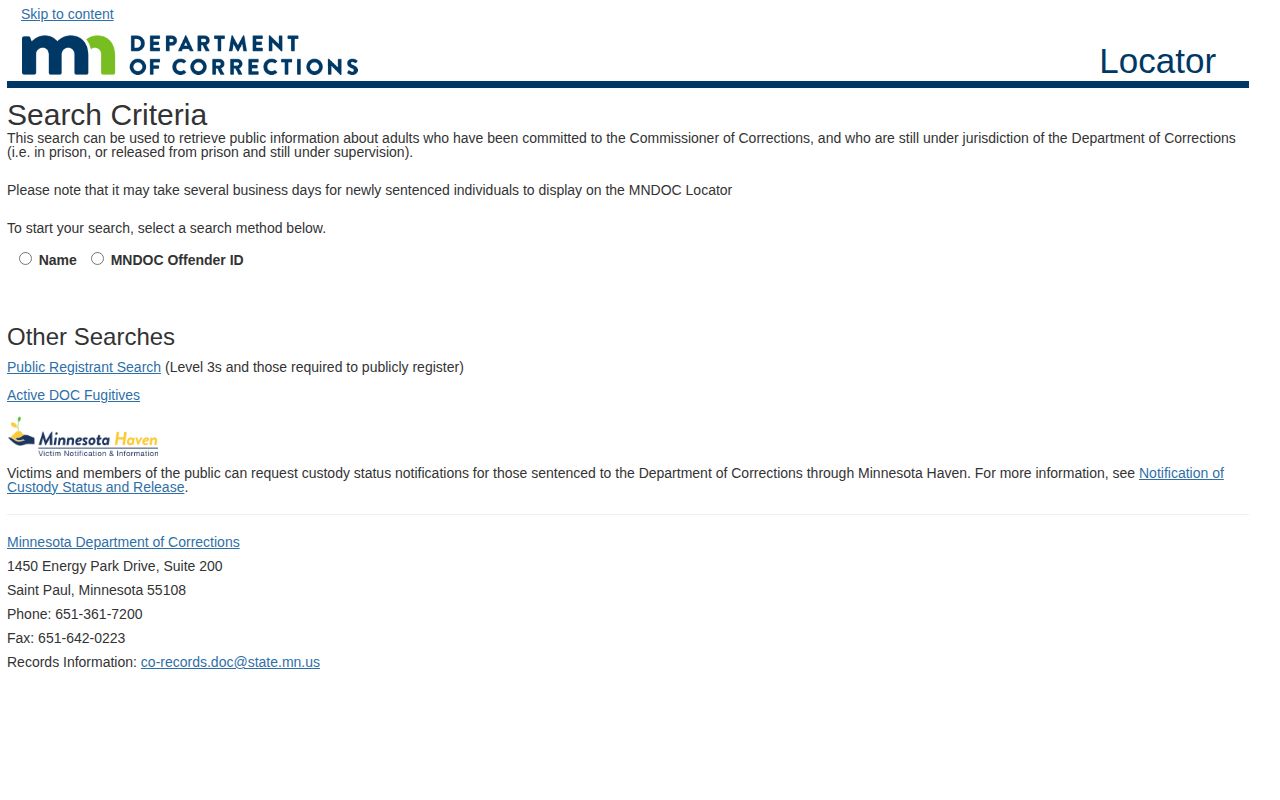
The search must be paired with the record detail. A results-page name by itself cannot support a Lake County release-date conclusion.
Note: Preserve the date label and the date checked because a later sentence audit or custody event can change the public display.
Minnesota Release-Date Sentence Ratio
Minnesota's ordinary fixed executed felony framework is not an 85 percent rule. For covered offenses committed on or after August 1, 1993, Minnesota Statutes section 244.101 sets a minimum prison term equal to two-thirds of the executed sentence and a maximum supervised-release term equal to one-third. That is about 66.7 percent in confinement as the starting framework.
The ratio is not a personal release promise. Mandatory minimums, conditional-release terms, life or old indeterminate sentences, consecutive cases, specialized programs, disciplinary confinement, and new warrants can change how a particular judgment operates. Jail credit and later court modifications also require a formal sentence audit.
Supervised release is still part of the sentence. Leaving prison after the confinement portion does not mean final discharge. The DOC record may show the person in the community under supervision, along with an agent, district, and later expiration date.
Minnesota Earned Release Credit
The Minnesota Rehabilitation and Reinvestment Act creates earned incentive release credit tied to goals in an individualized rehabilitation plan. The statutory framework appears in section 244.43, section 244.44, and section 244.45. The public anticipated date may reflect an agency calculation under those rules, but a reader should not attempt to award credit from outside the DOC process.
Section 244.44 presently permits earned incentive release credit up to 17 percent of the total executed sentence. It cannot reduce the prison term below one-half of that sentence, and it does not reduce the total supervised-release term. Facility-rule violations or criminal acts may lead to revocation. Certain groups, including life sentences and specified older sentence structures, are ineligible.
Earned compliance credit under a different provision affects active supervision and possible abatement. It should not be described as an earlier physical prison-release date. The two concepts occur at different stages. One can affect the confinement calculation, while the other concerns the course of community supervision.
Why Lake County Release Dates Change
An anticipated date can move even when the original sentence remains the same. The change may come from credit review, discipline, a new hold, a revised court order, release-program approval, or a specialized statutory rule. The record should identify the responsible system before a cause is assigned.
| Factor | Possible effect | Best source |
|---|---|---|
| Jail credit or sentence audit | Corrects the time credited toward the sentence | Sentencing court and Minnesota DOC |
| Disciplinary confinement | Can extend prison confinement, in some cases toward expiration | Minnesota DOC |
| Earned incentive credit | May advance confinement release within statutory limits | Minnesota DOC calculation |
| Detainer or warrant | May prevent community release or lead to another custody system | Holding agency, court, or Sheriff |
| Court modification or new case | Can alter the controlling sentence or add custody exposure | Court record |
| Board or program decision | May set, continue, deny, rescind, or revise a planned release | DOC or applicable release authority |
A detainer is a request or legal basis for another agency to take or keep custody. It may mean the person leaves one facility but does not enter the community. A new DOC facility or another county roster can therefore be evidence of transfer rather than a completed release.
Board review also needs careful wording. For the narrow sentence groups under Minnesota's Supervised Release Board, a hearing can set a projected date, continue the case with directives, grant release, or deny it. A scheduled hearing or favorable planning step does not prove a physical exit. Later rescission or revocation may change what had once been planned, so the current DOC status and the Board's decision record should be read together.
Lake County Jail Release Calculation
The DOC two-thirds framework and earned-credit statute should not be applied to a sentence served at Lake County Jail. Obtain the sentencing order, any credit for time served, and the Sheriff's recorded calculation. The county publishes no jail good-time calculator and no general weekend-adjustment policy.
Lake County Court Administration can supply the court-side sequence, while the Sheriff's Office owns the jail custody record. The Sheriff is at 613 3rd Avenue, Two Harbors, MN 55616, with the main line at 218-834-8385. Published administrative hours are weekdays from 8:00 a.m. to 4:30 p.m. Those office hours are not a promise about when releases are processed.
Minnesota Statutes section 244.05 includes day-shifting rules for certain DOC supervised-release dates that fall on Fridays, weekends, or holidays. Treatment can depend on the offense date. The statute governs its stated DOC scope and should not be recast as Lake County Jail's local release schedule.
Note: Ask Lake County for the recorded calculation instead of importing a state-prison formula into a county-jail sentence.
Confirm a Lake County Release Date
Confirmation requires both status and event evidence. For a state prisoner, compare the DOC detail page with the actual release or confinement-release field available through DOC records. For a county detainee, use the Sheriff's permanent custody record and the court case. For a federal prisoner, use the BOP route rather than either Lake County or Minnesota DOC.
A VINE notice can help monitor a future county-jail custody change. The Lake County VINELink check explains how to select Minnesota, match one person, and register a phone, text, email, or supported app channel. Its event label matters because release, transfer, escape, and death are distinct triggers.
Notification is not a certified release record. Feed timing, spelling, a transfer, or custody outside a participating system can create a no-result or delayed message. When the exact date controls a court or legal step, request the document from the agency that created it.